
French Troops Board Crude Carrier Connected to Russian Covert Armada
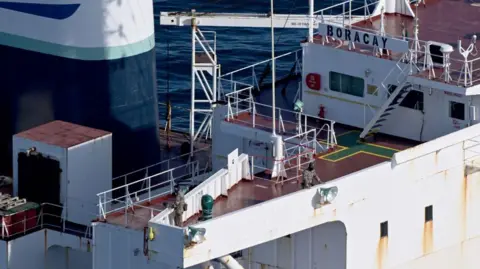
France's soldiers have boarded an crude carrier believed to be a component of the Russian shadow fleet, used to circumvent sanctions enacted due to the conflict in Ukraine.
The ship departed from Russia last month and was near the shoreline of the Scandinavian nation when unknown drones forced the temporary shutdown of multiple airports recently. It has been stationed off western France for a short period.
Government Comments
President Emmanuel Macron said the crew had carried out grave violations at an European Union leaders' meeting in the Danish capital on Wednesday but did not elaborate.
Kremlin spokesman the official declared Russia had no knowledge of the vessel.
AFP quoted a insider as indicating French armed forces had boarded the tanker on the weekend.
Legal Probe Details
Prosecutors in the French port city have opened an inquiry on multiple charges: refusing an order to halt and failing to explain the nationality of the ship's flag.
The French president declined to be pressed on the issue of whether the ship may have been utilized as a platform for the aerial operations that caused such chaos in Denmark last week.
Context on Restrictions
Many Western nations imposed economic measures on Russia's energy by limiting imports and setting a limit on the cost of its crude following Russia's comprehensive military action of the neighboring country in 2022.
To evade these restrictions, Moscow assembled what has been referred to as a covert armada of tankers whose ownership and movements could be obscured.
Russia is thought to have a collection of hundreds of tankers which are registered in other countries and are employed to sell abroad its petrol. The French leader indicated that Russia's covert armada included from six hundred and one thousand vessels.
Ship Information
The tanker, alternatively called Pushpa and a third name, is a Benin-flagged ship but has been designated under British and EU restrictions on Russia.
It was detained by Estonian officials earlier this year for operating without a valid country flag.
It had set off the Russia's harbor of the location outside the city on 20 September and sailed through the Baltic Sea and past Denmark before entering the North Sea and carrying on through the English Channel.
It had been scheduled to arrive in Vadinar in the northwest of the South Asian nation on 20 October, according to data from the Marine Traffic online service. However it was followed by a France's naval vessel after it rounded the Brittany coast and then altered course and moved east towards the French coast.
Regional Tensions
EU officials have been meeting in the Danish capital under urgency to strengthen European defence after a series of Russian incursions into European airspace, and days after drones attacked Danish airports.
The capital's airfield, then multiple the nation's airports and military sites on the Jutland region, faced aerial disruption last week.
Danish leader Mette Frederiksen told reporters that in the view of Europe there is a single nation... prepared to threaten us and that is Russia, and therefore we need a very strong answer back.
The nation's law enforcement have not found any evidence that the country was behind last week's drone disruption, but Frederiksen linked it explicitly to additional unconventional threats such as Russian drones over Poland.
It was a component of a pattern that had to be considered from a EU-wide viewpoint, she told journalists on Wednesday.
The incursions have become most acute for countries on the European Union's eastern flank such as Poland and Estonia.
A number of member states have already supported proposals for a multi-layered drone wall to rapidly identify, then track and eliminate Russian unmanned aircraft.